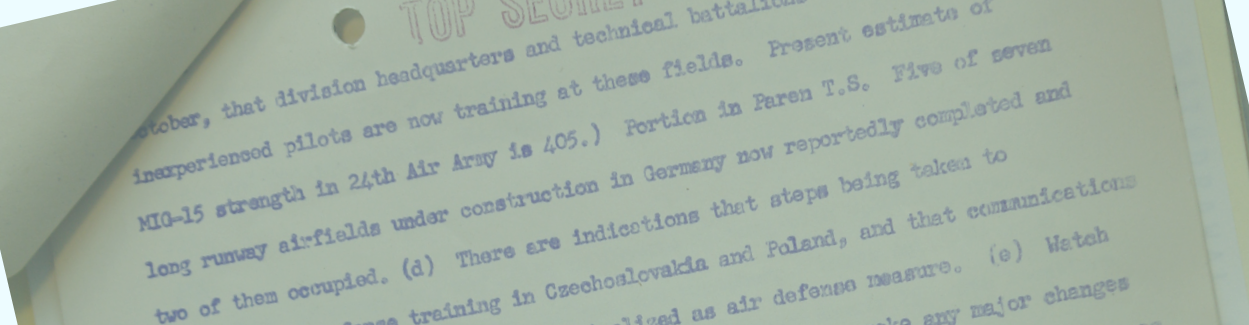
Secrecy has long been central to international politics. For decades, the field of International Relations did not often address it. Much of my research, including two award-winning books, addresses the secret side of international politics. This includes the links between secrecy, war, and escalation and analyzing the role of secrecy in cooperation and global governance. I am currently working on a third book about “intelligence infrastructure” — i.e., the physical sites and installations which are often required to conduct foreign surveillance — and its importance to geopolitics. More recent work addresses other topics in projects on implicit racial bias within foreign policy institutions, obtaining elite consensus on U.S. postwar multilateralism, the debut of atomic weaponry, and the role of language and maps in foreign policy bureaucracies.
For more on my research and background, see my CV. A good overview of my secrecy-related research is in this podcast episode.
Featured article
Carson, Austin, Eric Min, and Maya Van Nuys. “Racial Tropes in the Foreign Policy Bureaucracy: A Computational Text Analysis.” International Organization: 1-35.

Secrecy, war, and escalation

Secret Wars: Covert Conflict in International Politics. Princeton University Press, Princeton Studies in International History and Politics. 2018.
The book analyzes the covert side of five major 20th century conflicts, introducing a new theory of secrecy linking its use to states’ efforts to limit the scale and scope of conflict in an age of industrialized warfare and nuclear weaponry. The theory is built, in part, on adapted insights from Erving Goffman about secrecy and the “back stage collusion” we use in everyday life to define our social encounters and avoid crises. I analyze covert military intervention before, during, and after the Cold War. The book builds on the award winning article “Facing Off and Saving Face” (IO, 2016) and features case studies of the Spanish Civil War, Korean War, Vietnam War, the 1980s war in Afghanistan, and Iraq after 2003.
- Winner, Lepgold Book Prize, best book in international relations in 2018
- Honorable Mention, Best Book, APSA Conflict Processes Section, 2018/2019
- H-Diplo/ISSF Roundtable on Secret Wars
- Book discussion at Wilson Center / CSPAN American History TV; book discussion at Stimson Center
- Q&A on the book, First Time Author Spotlight, Princeton University Press blog; Q&A on the book, E-IR
- End-of-2018 reading lists: War on the Rocks; Stanford CISAC. End-of-2020 list Krulak Center
- Book reviews: Foreign Affairs, Political Science Quarterly, American Historical Review, Lawfare, War on the Rocks, Small Wars Journal, International Social Science Review, Naval War College Review, Special Operations Journal
- Sample: Chapter 1
Related articles and manuscripts

Facing Off and Saving Face: Covert Intervention and Escalation Management in the Korean War, International Organization, 70 (1), 2016, pp. 103-131. [PDF]
–Winner, Best Security Article Award, International Security Studies Section, International Studies Association 2018.

Covert Communication: The Intelligibility and Credibility of Signaling in Secret (with Keren Yarhi-Milo), Security Studies, Vol 26, No 1, 2017, pp. 124-156. [PDF]
Secrecy, cooperation, and global governance
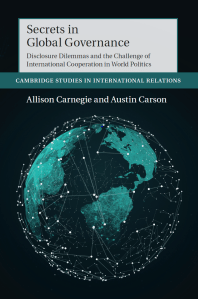
Secrets in Global Governance: Disclosure Dilemmas and the Challenge of International Cooperation. With Allison Carnegie. Cambridge University Press, Cambridge Studies in International Relations Series. 2020.
What makes cooperation in the international system so hard? How do international organizations (IOs) help states overcome these barriers? Scholars have long argued that IOs help reveal violations of international rules. Secrets in Global Governance introduces and theorizes the opposite institutional function, showing how international organizations use “confidentiality systems” — organizational secrecy by another name — to solicit sensitive information from states and better identify rule violations.
In the book, we argue that investigating compliance with rules increasingly requires access to sensitive kinds of disclosures for everything from nuclear proliferation to war crimes to international trade. Intelligence disclosed by governments, for examples, can be the difference between spotting violations, documenting them, or missing them entirely. We assess a disclosure dilemma: by disclosing such information, states can help identify violations but also risk commercial and national security harm. We show how IOs mitigate this dilemma by safeguarding such disclosures with confidentiality systems, or secrecy. This allows them to better identify and document violations. We develop this unique role for IOs — and the normative and practical challenges it often generates — in chapters on war crimes, trade disputes, nuclear nonproliferation, and foreign direct investment arbitration.
- Winner, Best Book Award, APSA’s International Collaboration section, 2021
- Book website at Cambridge University Press
- Sample: Chapter 1
Related articles and manuscripts
The Spotlight’s Harsh Glare: Rethinking Publicity and International Order (with Allison Carnegie), International Organization, 72 (3), 2018, pp. 627-657. [PDF] [Appendix]
–Winner, Robert Keohane Award, Best Article by Untenured Scholar, 2018.
–Honorable Mention, Best Article Award, International Security Section, American Political Science Association, 2019.

The Disclosure Dilemma: Nuclear Intelligence and International Organization (with Allison Carnegie). American Journal of Political Science, 63 (2), 2019, pp. 269-285. [PDF]
–First article to undergo AJPS verification & transparency for qualitative research. Related: Jan Leighley, “Celebrating Verification, Replication, and Qualitative Research Methods at the AJPS,” March 20, 2019. Allison Carnegie and Austin Carson, “Our Experience with the AJPS Transparency and Verification Process for Qualitative Research,” May 9, 2019.
Reckless Rhetoric? Compliance Pessimism and International Order in the Age of Trump (with Allison Carnegie), Journal of Politics, 81 (2), 2019, pp. 739-746. [PDF]
UN Peacekeeping After the Pandemic: An Increased Role for Intelligence (with Allison Carnegie). Survival 63.2 (2021): 77-83.
Scared to Share: Why Fighting Pandemics Requires Secrecy, Not Transparency (with Allison Carnegie). Global Perspectives 4.1 (2023): 57639.
The Power in Opacity: Rethinking Information in International Organizations (with Alexander Thompson). In International Institutions and Power Politics: Bridging the Divide, eds. T.V. Paul and Anders Wivel, Georgetown University Press, 2019.
Other Research: Senility, Racial Stereotypes, and More
Carson, Austin, and Matthew J. Conklin. “Co-Optation at the Creation: Leaders, Elite Consensus, and Postwar International Order.” Security Studies 31.4 (2022): 634-666. [Ungated PDF]
Byun, Joshua, and Austin Carson. “More than a Number: Aging Leaders in International Politics.” International Studies Quarterly 67.1 (2023). [Ungated PDF]
“Racial Tropes in the Foreign Policy Bureaucracy: A Computational Text Analysis” (with Eric Min and Maya Van Nuys). International Organization, Vol 78, Issue 2, 2024, pp. 189-223.
Carson, Austin and Adam Saxton. “History, Archaeology, and Espionage as Improvised Legibility.” European Journal of International Relations, forthcoming.
Austin Carson. “The Unique Challenges of Covert Missions: How Leaders Assess the ‘Quiet Option.’” In Inside the Situation Room: The Theory and Practice of Crisis Decision-Making, eds. Hillary Rodham Clinton and Keren Yarhi-Milo. Oxford University Press (2025).
Byun, Joshua, and Austin Carson. “‘A Fair Background to Show its Strength’: Hiroshima and the Spectacular Debut of Atomic Weaponry.” Revise & Resubmit, American Political Science Review.
“Keeping It Professional: Language and Bureaucracy in the Cold War” (with Eric Min). Working Paper.
“Does Intelligence Pay? Assessing Information Advantages in Declassified Intelligence Briefings” (with Eric Min). Working Paper.
“All Over the Map: Leaders, Bureaucracy, and Geographic Orientation” (with Ari Weil). Working Paper.
 Austin M. Carson